The taxis we took in the 1990s-domestic cars.
With the continuous improvement of people’s living standards, owning a car is no longer an unreachable dream. The increase in the number of private cars has brought about congested road conditions. With the rising oil price, scarce parking spaces and high parking fees, many people reluctantly give up self-driving and take public transportation, and "taking a taxi" has naturally become the best choice for people to travel. Earlier, we had a taste of the global taxi culture (click to enter the special edition of global taxi culture). Today, the editor will take you back to the domestic taxis that once appeared around us, and the time is locked in China in the 1990s. Can these taxis that once facilitated our travel evoke your unforgettable memories?

Cheap taxis-"noodles"

From the late 1980s to the early 1990s, with the gradual improvement of people’s living standards, more and more people began to choose "taking a taxi" as a new way of travel. At that time, the development of China’s automobile industry was still in its infancy, and consumers’ demand for taxis was expanding day by day, but no suitable model met the demand for taxis in the taxi market at that time. The municipal government put forward the development policy of "one person waving, several cars waiting", and the first batch of "face-to-face" taxis, mainly Beijing Friendship Taxi Company, was put into operation.

For a time, this kind of miniature bread taxi with small size and low price was quickly loved by people. Although the "sparrow" is small, it has a huge stomach. This kind of "face" can easily hold 5 or 6 adults, and sometimes it is not a problem to squeeze 10 people. In the past, I often saw people pushing bicycles to hit Mian, and even a few people moved by taxi, which proved that Mian has been deeply integrated into people’s daily lives.


However, the "surface" is not perfect, and the unstable quality is its biggest defect. In summer, the car is extremely stuffy. However, faced with the price of 1 yuan per kilometer after 10 kilometers in 10 yuan, consumers can still tolerate its shortcomings. In 1993, there were as many as 35,000 taxis in Beijing, accounting for 51% of the total number of taxis in the city. Because almost all the "faces" were painted in yellow, the "yellow worms" that looked all over the street became unique in Beijing at that time. Let’s review these taxi models that have been closely related to our travel.
Changhe CH1010 (prototype-Carry ST-90V)

The popularity of "Mianmian" in the domestic taxi market is also due to the birth of the first mini-van in China. In 1978, Deng Xiaoping proposed that military enterprises should use surplus production capacity to produce civilian products. In April 1979, the Central Committee put forward the 16-character policy of "combining the army with the people, combining peacetime and wartime, giving priority to the army and supporting the army by the people". Changhe Automobile, which has experience in bus production, received the production task, and the prototype was selected as Suzuki Carry, which won the best-selling mini-car in Japan for eight consecutive years.

In 1979, Suzuki Carry ST-90 was launched in Japan. The car was divided into two versions: mini van and mini, with a three-cylinder engine with a displacement of 543 ml and a four-cylinder engine with a displacement of 797 ml. In 1980, Changhe Automobile introduced the Japanese Suzuki Carry ST-90 minivan for decomposition, mapping and design.

At the end of 1982, the first domestic ST-90 prototype was successfully trial-produced. The product number was CH730, and it was later changed to CH110X and CH1010. This is the well-known "Changhe Noodles". Changhe CH1010 minivan is equipped with a DA462 engine with a displacement of 797ml (its technology originated from Suzuki F8A) produced by Dongan Engine Factory, with a maximum horsepower of 35 HP (26kW)/3500rpm and a maximum speed of 51N·m/3500rpm. The engine is matched with 4 speeds and the maximum speed is 95km/h.. From its birth in 1982 to its discontinuation in 2000, Changhe CH1010 series mini-cars produced a total of 151,629 vehicles.
(prototype-hijet)

When it comes to another main model in the "noodle" market, I believe many people still remember the name of Tianjin Dafa. "Make a fortune, buy a fortune, make a fortune!" Not many people remember this advertisement that was once broadcast on CCTV, but we can clearly feel the position of Tianjin Dafa in people’s minds at that time. The prototype of Tianjin Daihatsu is a minivan named Hijet.
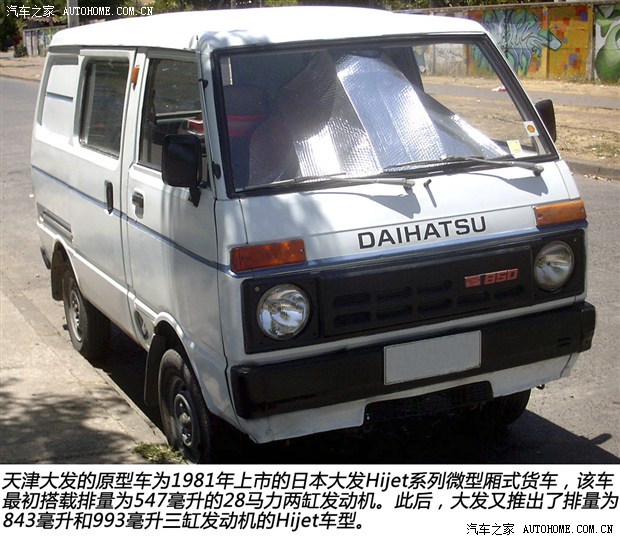
In March 1981, Hijet(S65) was officially launched in Japan. At first, Hijet was equipped with a two-cylinder engine with a displacement of 547 ml, with a maximum power of 28 HP (21kW)/5500rpm and a maximum torque of 41 N m/3500 rpm. Later, it introduced a two-cylinder engine with a displacement of 547 ml and a three-cylinder engine with a displacement of 843 ml and 993 ml. Hijet’s body size is 3195mm long, 1395mm wide, 1660mm high and 1820mm high.

Although technically speaking, Dafa Hijet was not advanced at that time, its biggest selling point was its low price and good practicability, which just met the demand of China taxi market and national cars at that time. In 1983, the leading group of Tianjin mini-car construction was formally established and went to Japan for investigation, and finally the Hijet 850 mini-van and Charade sedan produced by Daihatsu Motor Company of Japan were selected.

In 1984, Tianjin Automobile Factory introduced Daihatsu’s assembly line from Japan and began to produce Daihatsu Hijet minivan. The model made in China is named Tianjin Dafa (Huali) TJ110, which is equipped with a three-cylinder engine with a displacement of 843 ml, the maximum power is 29kW/5500rpm, the maximum torque is 59 N m/3200 rpm, and it is equipped with a 4-speed manual transmission, with a vehicle mass of 760kg. The original Tianjin Dafa was produced in CKD mode. In 1987, the first Tianjin Dafa taxi appeared on the streets of Tianjin. A few years later, in Tianjin alone, there were 50,000 "Huang Dafa" cars hanging on the top lights of taxis and driving in the streets.
Liuzhou wuling LZW6330 (prototype-minicab)

At that time, the domestic "face" taxi army was also mixed with some niche models, and everyone may have no impression of Wuling’s "face". In the early 1980s, Liuzhou Tractor Factory (the predecessor of Liuzhou Minicar Factory) imported a Mitsubishi Minicab(L100) mini-car from Japan. After the vehicle was disassembled, workers manually measured and plotted the parts one by one. In January 1982, the LZ110 prototype car made by workers was successfully born, and it was named "Wanjia" brand at that time. In 1985, Liuzhou Tractor Factory was officially renamed as Liuzhou Mini-car Factory and Mitsubishi technology was officially introduced. liuzhou wuling LZW6330 was born under this background.
Minivans in Jilin and Songhua River


At that time, almost all minivans that can be called by name in China were used as taxis, and Jilin brand minivans and Songhua River minivans were also active models. Different from other models imported from foreign mature brands in the same period, Jilin brand minibus is produced by imitating domestic minibus and improving it. Compared with other minibuses at that time, the Songhua River minibus launched by the car has more spacious interior space because of its longer wheelbase and larger vehicle size.

"Face-to-face" brings great convenience to people’s travel, but serious exhaust pollution also makes "face-to-face" slowly come to an end. In 1998, as an emergency measure to control air pollution in Beijing, the Beijing Municipal Government launched a large-scale "anti-vice" campaign. In 1999, 22,000 "Faces" were completely eliminated, replacing "Faces" as the official upper position of taxis.