Want to work abroad to earn a lot of money? You need to read this cheat-proof cheat sheet first.
International Online Special: On April 18th, the Chinese Embassy in Malaysia issued a "Reminder on Working in Malaysia" in official website. As mentioned in the article, recently, China has received many cases of seeking help from Malaysian laborers. Most of the laborers involved believe in the false propaganda of domestic labor companies that have no qualifications for foreign labor cooperation, and go to Malaysia to work illegally by applying for tourist visas. Although a high intermediary fee was paid in advance, due to the acceptance of the employer, it was impossible to apply for a legal work visa, and it was even more impossible to get a salary. In this regard, the Embassy reminded the laborers in Malaysia not to believe in the propaganda or personal commitment of illegal labor agencies, but to fully understand the situation and work content of the employing units, select enterprises with foreign labor cooperation qualifications, sign written contracts, and apply for legal work visas.
What happened behind the news released by the embassy?
Twenty-five workers were tricked into working in Malaysia and stayed at the airport to eat biscuits to satisfy their hunger.
The president noticed a report in Singapore Straits Times on April 17th. On April 10th, 25 China workers were deceived to Johor by a fake intermediary. Upon arrival, they found that there was no job to do at all, and the visa in hand was not a work visa but a tourist visa. Twenty-five people had no choice but to return to the airport. As they didn’t bring any money, they had to eat bread and biscuits to satisfy their hunger and wait for help.
These 25 people come from Jilin, Henan, Sichuan and other places. In the name of a famous construction company in China, the fake intermediary lied to them that Johor needed a large number of construction workers, with a construction period of about 4 to 5 years and a monthly salary of 13,000 RMB as bait. After charging a total of 60 thousand yuan, the fake intermediary took them to Malaysia.
Chen Hangpeng, consultant of China Chamber of Commerce and Industry, went to the airport to help at the request of the embassy. He said that at present, there are many large-scale real estate projects developed by China manufacturers in Iskandar, Johor. And some fake intermediaries take this opportunity to deceive farmers in China. At present, many farmers have been cheated.
Fortunately, the China Embassy in Malaysia helped them and sent them back to China in two batches on April 16th and 17th.
Fuguo Wang (39 years old), a farmer from Jilin Province, said in an interview that he was just an ordinary citizen. He only went to Malaysia to earn money to make his family live a better life, even at the expense of selling land and cattle or borrowing money from relatives and friends in his hometown. Unexpectedly, his hard-earned money was not earned, and all the money he had painstakingly raised was cheated.
Shi Chuanyi (46 years old) from Jilin Province said that he believed the construction company based on the intermediary that it was very famous in China and that many people participated in it.
Lu Ping (48 years old) from Jilin Province said that the most important thing at present is how to return to China, and then I hope to get my money back through legal channels.
Another fraud case of going abroad to work.
Simple deception can also make people fall for it easily.
With the dream of earning a high salary, it is not uncommon to be cheated in the process of seeking to work abroad. In 2016, the police cracked a major case. A company without foreign-related work qualifications defrauded more than 500 people of more than 19 million yuan in agency fees on the grounds of introducing them to work abroad. At that time, public opinion was in uproar, and in fact, scams of all sizes occurred in all provinces.
In 2013, Weifang chef Liu Liang (pseudonym) paid 65,000 yuan to a fake intermediary and was arranged to work in Turkey. In fact, he got a tourist visa, not a work visa. After arriving in Turkey, he could only work as a black laborer. Many restaurants recognized him as a black laborer, not only did they not pay for his work, but they also drove him away again and again. There are 11 people who have the same experience with him, and the liar is just an ordinary person with junior high school culture.
In 2015, Huang Jiawei, a native of Shandong Province, charged more than 200 workers an introduction fee of about 400,000 yuan on the pretext of helping them go abroad to work, and then into thin air.
In June, 2016, a man surnamed He in Suining, Sichuan Province sent a single call to recruit migrant workers abroad, charging an agency fee of 5,000 yuan per person, and got a total of 550,000 yuan from 106 migrant workers, and then disappeared with their passports. Fortunately, the police finally arrested He.
In September 2016, more than 70 workers went to the airport to check in with the travel itinerary and visa given by the intermediary company, and were told that travel itinerary was fake. They originally wanted to work in Turkey, but they didn’t expect to be defrauded of an intermediary fee.
In March 2017, police in Shangrao, Jiangxi arrested a man surnamed Ji. He made up a lie that he could arrange workers to work in Libya, Africa, and earn 200,000 yuan a year. Many victims signed a contract with him and paid a deposit of 2000 yuan respectively. But then he started to disappear and was eventually called the police by the victim.

In April 2017, the Yueyang County Court of Hunan Province sentenced a fraudster, Jiang. From 2015 to 2016, without obtaining the qualification or authorization of the agency for overseas work, he collected the deposit for overseas work from many people on the grounds of recruiting workers to work in Maldives and Malaysia, and the deposit amounted to 156,900 yuan. Later, on the pretext of being full and arranging to go to other places, he postponed the time of going abroad for various reasons and used the deposit for personal expenses.
From the above examples, we can see that even low-level deception can make some people eager to make money fall for it, not to mention those elaborate scams. There are too many such cases. Some people have been cheated abroad and have been in extremely dangerous environment for a long time, even losing their lives.
You need to know this to fight against cheaters.
One: check qualifications
It is necessary to check the industrial and commercial business license of the intermediary company to see if he has the qualification to operate overseas labor services. The qualification of overseas labor service operation needs to be approved by the Ministry of Commerce (formerly the Ministry of Foreign Trade and Economic Affairs). According to the latest statistics of the Ministry of Commerce, as of February 2017, there were 828 enterprises with foreign labor cooperation qualifications.
Where can I check?
1, the local government department of commerce (Foreign Trade and Economic Cooperation Department, bureau) of the foreign economic office.
2. Complaint agencies for expatriate laborers in china international contractors association. (Telephone number of complaint center: 010-84242447 or 84242557, http://www.chinca.org/cms/sites/quanyi/index.jsp, official website, which introduces various policies, regulations, cases, guides for going abroad, etc. )
3. Website of the Ministry of Commerce. (official website Address http://www.mofcom.gov.cn/)
The operating company may also be required to produce a copy of the Qualification Certificate for Foreign Economic Cooperation. If it is an entrusted agency, it is necessary to produce a copy of the contract signed between the operating company and the employer.
Two: look at the visa
The visa must be a work visa, not a tourist visa, a business visa or a study visa, or you will be in danger of being repatriated or forced to work illegally.
Three: do research.
Have a general understanding of the local customs, laws and regulations of the workplace to avoid being dismissed by the employer for various reasons and defrauding the agency fee.
Four: not credulous
Don’t believe it easily when you don’t need an interview, have no training, don’t sign a contract, just verbally promise a high salary and charge an agency fee. This situation is often a scam, or it is difficult to get the expected salary.
Five: Ask more questions
Be sure to know the names of the countries and regions, operating companies and foreign employers you are going to; What work to do, working period, probation period, working days per month or week, working hours per day; Remuneration and treatment, including monthly basic salary, overtime and holiday overtime, salary and overtime payment method.
The president here suggests that if you are really difficult to judge, please consult more government departments and relevant institutions, and don’t be fooled by spending money to save trouble. If you are cheated and encounter disputes, you must seek help from China or local police and China’s overseas institutions in time.
How much does it cost you to go abroad legally?
To work abroad through an intermediary, you need to pay these fees:
One: the agency fee of the labor service company. Regular labor service companies help to handle the matters of going abroad, and they also have the responsibility and obligation to deal with emergencies after going abroad.
The agency fees charged by labor service companies vary according to the recommended job location, project, salary and treatment, country and other conditions, generally ranging from 5,000 to 15,000 in African countries. The costs of Singapore, Japan and South Korea are relatively high. For example, the agency fee in Singapore is 25,000-30,000 RMB, and a few will have an agency fee of 18,000 RMB (meeting the requirements of specific education, language and age).
Two: visa processing fees. Note that you must apply for a work visa to work abroad. According to different countries, the costs are different, but these costs can be easily found.
Some countries, such as Australia, New Zealand and Canada, require a basic knowledge of English for official work visas, and those that are not required may be fraudulent. There are also some countries where only certain types of jobs can get work visas. Please be sure to understand clearly.
Three: the cost of air tickets. This fee will vary from country to country.
Four: medical examination fee. Going abroad to work needs to go to the entry-exit medical examination hospital stipulated by the state. Don’t go to other hospitals without permission. At present, in addition to special industries such as catering, routine and infectious disease inspections are generally carried out. The cost is about 500-800 yuan.
V. Performance bond. Some employers also require employees who want to work abroad to pay performance bonds. The performance bond is also legal.
The performance bond is the deposit that you must work abroad according to the provisions of the Expatriate Labor Service Contract and the Employment Contract. The specific cost depends on the requirements of the enterprise. The performance bond is directly handed over by you to the employer who sent you abroad. After you return to China after fulfilling the labor contract, the employer will return the principal and interest of the performance bond to you in full with the receipt you submitted. If you fail to fulfill your obligations according to the contract, you have no right to ask for a refund of the deposit. Therefore, it is also necessary to pay special attention to prevent being trapped by unreasonable terms.
Current situation of migrant workers in China: about 1 million people are working abroad.
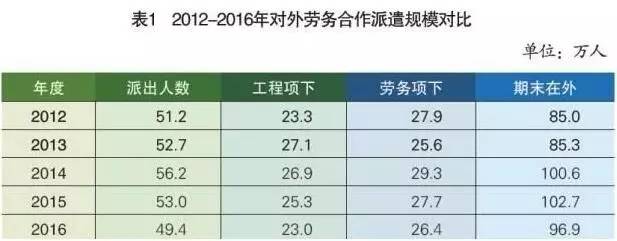
According to the statistics of the Ministry of Commerce, in 2016, China’s foreign labor cooperation sent 494,000 laborers of various types, a decrease of 36,000 from the previous year; Among them, 230,000 people were dispatched under contracted projects and 264,000 people were dispatched under labor cooperation. In the month of December, 60,000 laborers of various types were dispatched, an increase of 2,000 over the previous year. At the end of the year, there were 969,000 foreign laborers, a decrease of 58,000 compared with the previous year.
As we can see from the following table, in recent years, about 1 million people have worked in foreign countries every year.
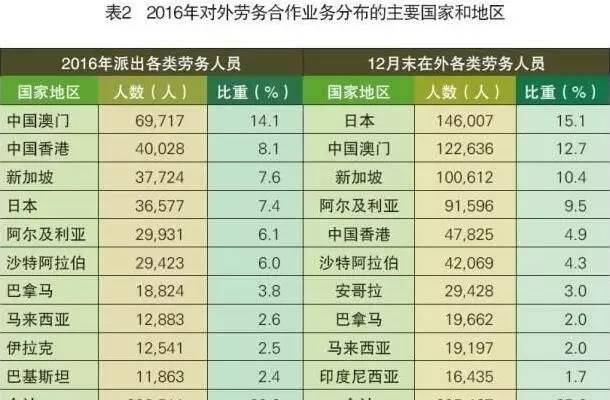
The main countries and regions they went to were:
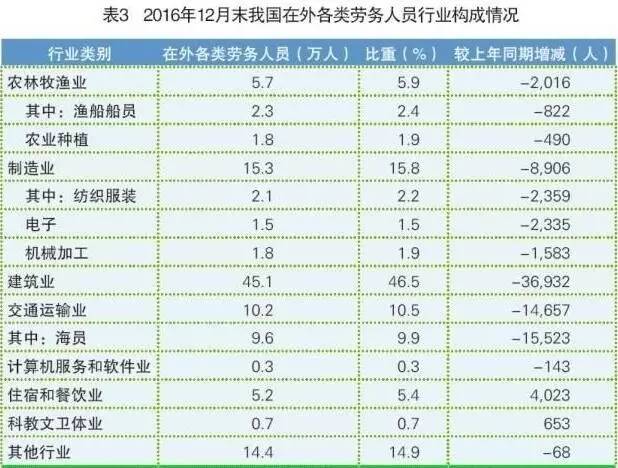
At the end of December 2016, the industry composition of migrant workers abroad:
In 2016, the top 20 companies for expatriate laborers were:
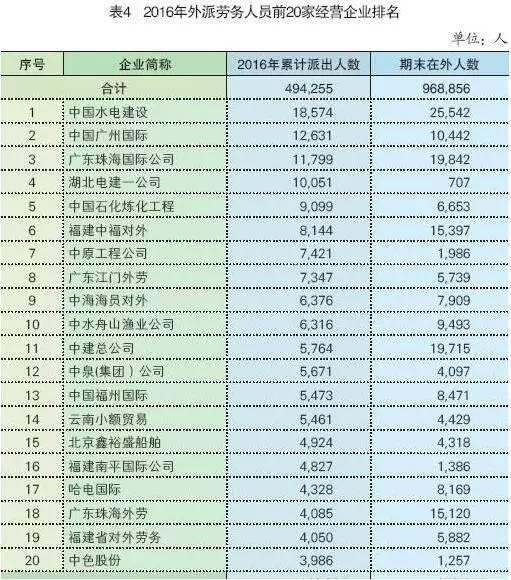
In addition, as of February 2017, there were 828 enterprises with qualifications for foreign labor cooperation, an increase of 17 over the same period in 2016. If you want to work abroad, please be sure to find a qualified enterprise.